CUSTOMER SUCCESS MANAGER / L4 PANEL
ACCOUNT: CATERPILLAR INC. · QUARTERLY EXEC REVIEW
Z. FIORELLA
Press Check
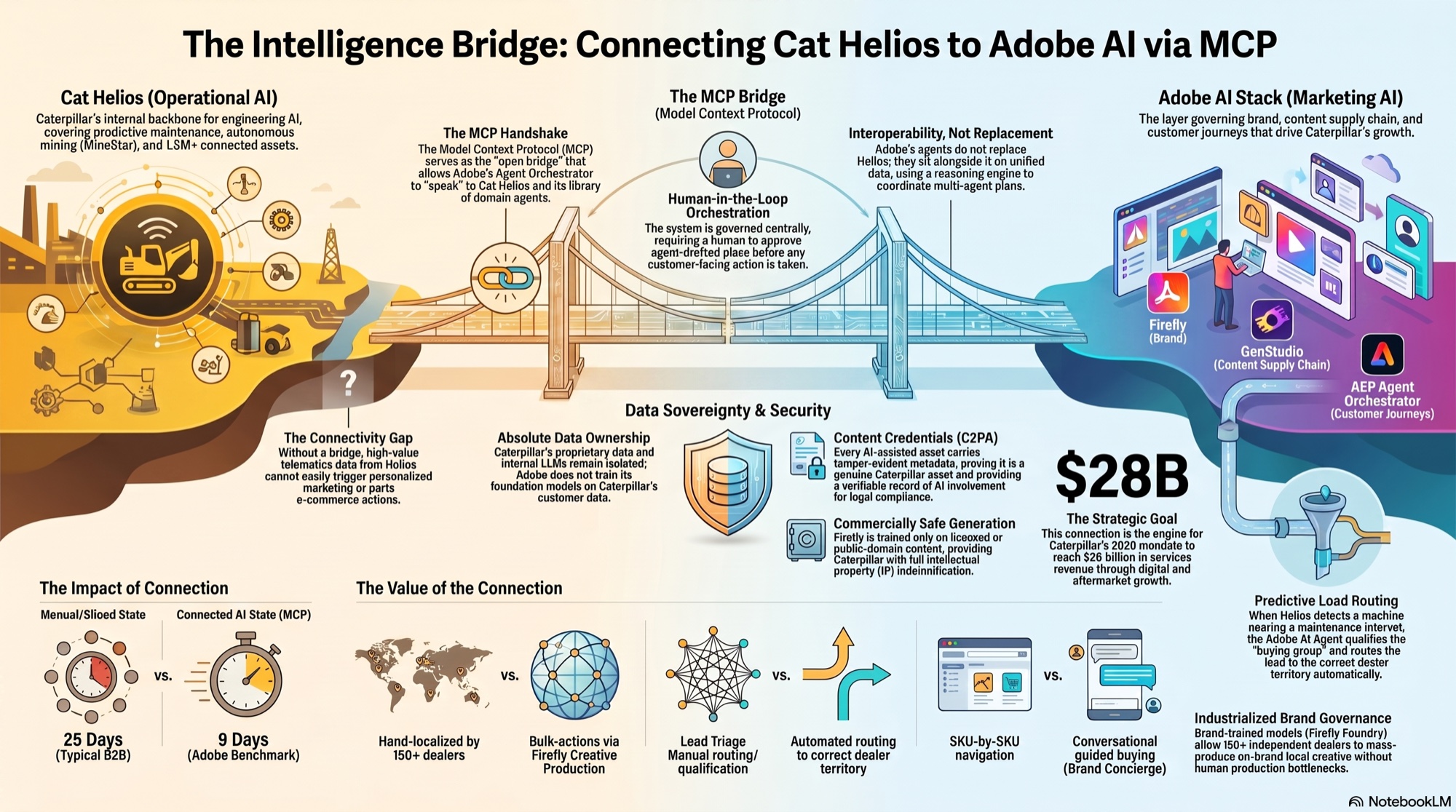
Caterpillar already runs almost all of Adobe Experience Cloud in production: the global websites, the campaigns, the analytics, the work management. What they have not turned on is the AI built to sit on top of it. No Adobe Firefly or GenStudio mass-producing on-brand creative for their more than 150 dealers, so dealers still localize content by hand. No Experience Platform agents routing aftermarket parts demand to the right dealer. No defense as buyers start asking ChatGPT, not Cat, which part to order. That layer is at $0 today. The gap is the whole opportunity.
The thesis, one page.
One move governs everything here: convert a healthy but flat renewal into the first account to activate Adobe's AI layer. The room opens on that, and everything else serves it.
The relationship is healthy. That is the risk.
About $11.3M a year in annual recurring revenue (ARR) across Adobe's products, plus about $950K for Ultimate Success, Adobe's top-tier success and support plan. Adobe is the system of record across the experience lifecycle. But Cat Digital, under Chief Digital Officer Ogi Redzic, already runs production AI in the business, while Adobe's generative and agentic layer sits at $0. Strong core adoption is exactly why flat is the threat. The moment to extend is when the core is this healthy.
Adobe owns the marketing AI fabric.
Cat already thinks natively in AI agents on unified data, so the Agent Orchestrator narrative lands on prepared ground. Three concrete wedges: brand-trained Firefly and GenStudio to industrialize on-brand dealer content across more than 150 dealers; Agent Orchestrator routing aftermarket demand to the right dealer on unified data; and winning the catalog in AI-search. Measured end to end, so the Ultimate Success spend pays for itself in plain view.
The line that wins the room
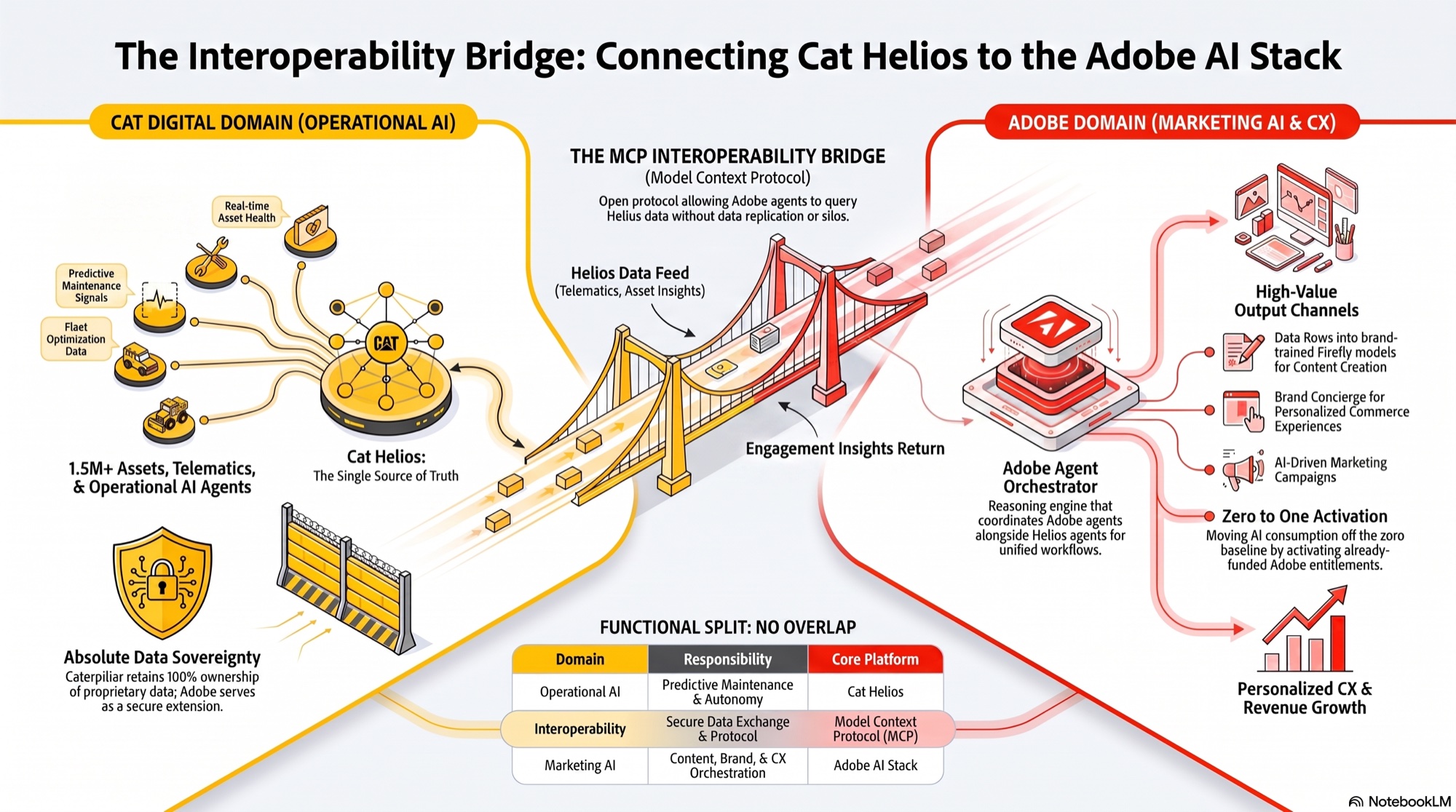
Cat Digital owns the operational and engineering AI: predictive maintenance, MineStar autonomy, condition monitoring on Helios. That is not Adobe's to win, and conceding it is what builds the credibility to claim the rest. The marketing and customer-experience AI layer is open, and Adobe is positioned to own it because Adobe already holds the content, brand, demand and measurement systems that AI has to act on. Adobe's agents interoperate with whatever large-language-model and agent stack Caterpillar standardizes on, through Agent Orchestrator and the open Model Context Protocol (MCP). They do not replace it.
Generative AI consumption: $0 to one use case, live and measured, this quarter. A budget owner who sees AI capability on the books with no return at renewal questions the entire about $11M footprint. The work is to convert one use case to value before that question is asked. Already-funded upside, not a failure.
The manual, in three movements
Plates 01 to 03. The account cold, the footprint, and a searchable arsenal of every Adobe AI capability against a Caterpillar scenario.
Plates 04 to 05. Discovery per panelist, and the eight plays where Caterpillar's sharpest pains meet Adobe's production AI.
Plates 06 to 09. The tools the panel was built with, the proof, the 30-minute run sheet, and the accuracy sheet.
Learn it before you walk in
Every product name and claim in this manual links to its source. Watch, read, then speak to it in your own words.
The account, cold.
Caterpillar Inc. (NYSE: CAT), the world's largest construction and mining equipment maker. Numbers are public or secondary sourced, treat as approximate.
Caterpillar is already a public Adobe AEM customer, implemented with partner Perficient for a consistent customer and dealer-facing experience. This is not a cold pitch. The footprint is a realistic extension of a stack they already trust, and the AI layer is the upsell on top. The credibility anchor for the entire conversation.
Razor and blades, at $65B
About $64.8B revenue (2024); FY2025 set an all-time record at about $67.6B. Lower-margin machine and engine sales pull through high-margin recurring aftermarket parts and service, about $26.1B in 2024, with a stated goal of about $28B services revenue by 2026. Three segments after a 2025 reorg: Construction Industries, Resource Industries, and Power & Energy (renamed from Energy & Transportation). Financial Products (Cat Financial) is the fourth line. Revenue is overwhelmingly B2B and almost entirely dealer-mediated.
about 160 dealers, 197 countries
Cat sells almost entirely through about 155 to 160 independent, locally owned dealers running more than 2,000 locations worldwide. Dealers drive about 85% of new machine sales and nearly 100% of aftermarket parts and service, and they own the local customer relationship. Caterpillar central supplies brand assets, campaign templates, product launches and digital lead feeds; dealers localize and execute. The central-to-local co-op model and brand governance across more than 150 independent businesses is the defining marketing-ops challenge, and the most direct Adobe fit.
Cat Yellow, governed across more than 150 dealers
Master brand is Caterpillar, "Cat." Visual identity is trademarked Cat Yellow (PANTONE 1235 C, close to #FFC300) plus black, the CAT wordmark and the yellow triangle under the A. The current "Modern Hex" trade dress (rolled out 2018 to 2020, explained here) replaced the legacy "Power Edge" look. Positioning is premium durability, "Built For It." Sub-brands include Solar Turbines, Perkins, Progress Rail, SEM, FG Wilson, MaK. The live problem is not a rebrand event, it is governing one premium identity across many sub-brands and more than 150 independent dealers, every day, at content scale.
more than 1.4 million parts, every format
Enormous, deep, multi-format. parts.cat.com alone exposes more than 1.4 million parts online; the broader catalog spans machines, engines and locomotives, each carrying spec sheets, build-and-price configurators, exploded parts diagrams, serial-number-specific lookups, and warranty/service docs, across many languages, regions, segments and sub-brands. A textbook high-volume, high-variant content supply-chain load.
Cat already ships production AI
Strong, real, in-production AI and digital program run by Cat Digital under Chief Digital Officer Ogi Redzic (joined 2018 from Renault-Nissan connected vehicles). Helios is the data and AI backbone, a library of domain agents acting through its APIs. In 2024 Cat launched a generative-AI service-recommendation engine, and the new Cat AI Assistant runs on it; condition-monitoring advisors use generative AI for pre-analyzed reports (about 50% faster decisions); predictive maintenance runs across more than 1.5 million connected assets; MineStar Command runs autonomous haul trucks. Implication for Adobe: Cat already thinks in "AI agents + unified data," so Agent Orchestrator lands on prepared ground.
parts.cat.com, more than $2 billion a year
eCommerce centers on parts.cat.com (frequent-buyer control center, more than 1.4 million parts), with online dealer parts sales surpassing $2B annually, roughly $10M per business day. Companion properties: Cat Central (DIY owner app), Cat Integrated Procurement for large fleets, customer portals (My.Cat.com), VisionLink telematics (more than 1.5 million connected assets), and the Cat App. Underneath sits Helios. Overarching goal: about $28B services revenue by 2026 via digital and aftermarket.
Unusually consolidated
Cat Digital, led by CDO/SVP Ogi Redzic, explicitly owns global marketing and brand, connectivity, enterprise data, analytics and AI, eCommerce, and aftermarket leads and insights. Brand, data, AI and commerce all sit under one digital leader inside the broader Digital, Technology & Distribution org. Single-owner structure means a cleaner enterprise-platform sale and a natural home for a unified CDP + content supply chain.
Pathways to Sustainability (AACE)
Framed as the energy transition, the Pathways to Sustainability program is organized around AACE: Autonomy, Alternative fuels, Connectivity and digital, and Electrification. About a 34% reduction in operational (Scope 1 and 2) carbon emissions versus a 2018 baseline. A distinct narrative track that must be personalized by audience and segment without diluting the core durability brand.
Where it hurts: the pains Adobe AI is built for
- Content supply chain can't scale: producing and localizing spec sheets, more than 1.4 million parts records, manuals, configurators and campaign creative across dozens of languages and sub-brands by hand.
- Brand governance versus local autonomy: keeping Cat Yellow and the Modern Hex identity consistent across more than 150 independent dealers and many sub-brands.
- Co-op / distributed marketing bottleneck: empowering dealers to run local campaigns without a central production chokepoint.
- Fragmented data: unifying Helios, the dealer management and customer relationship systems (DMS and CRM), VisionLink telematics and ecommerce into one view of the account, the person and the asset.
- Aftermarket lead routing: getting the right parts or service offer to the right customer and routing it to the correct dealer territory.
- Losing AI search: buyers increasingly ask ChatGPT and Perplexity which machine and which part, so owned content gets left out of the answer. Adobe calls fixing this generative engine optimization (GEO).
- Self-service personalization at scale: tailoring parts.cat.com across more than 1.4 million part numbers and very diverse customer types.
- Measuring return across the split funnel, headquarters to dealer to ecommerce, where the dealer often owns the end customer.
Public/secondary sources: Cat 4Q24 and 4Q25 results, cat.com dealer network, Digital Commerce 360, Equipment World. Treat precise figures as approximate.
The footprint & the whitespace.
Adobe is the system of record across the entire experience lifecycle, all in production. One line reads $0. That is the whole opportunity.
| Product | Sample ARR | Status | Read |
|---|
about $11.3M multi-cloud ARR across content, demand, work, optimization and measurement, plus about $950K Ultimate Success. ARR figures are the panel prompt's sample scenario.
Excellent core adoption sitting next to $0 consumption of the AI Platform they could already be entitled to, while their own Cat Digital org runs production AI. Adobe is behind its own customer on the exact vector the customer cares most about. Strong adoption is precisely why flat is the threat: the moment to extend is when the core is this healthy.
- Industrialize content: brand-trained Firefly Custom Models and Foundry with GenStudio, for on-brand creative across more than 150 dealers and many sub-brands.
- Agentic customer experience on unified data: the Experience Platform (AEP) Agent Orchestrator and its agents, sitting alongside Helios on Real-Time CDP, Adobe's customer data platform.
- Prove it and democratize it: the Experience Platform AI Assistant and Customer Journey Analytics, including the return on the Ultimate Success spend.
Learn each product, inside and out
The official overview to watch, and Adobe's own tutorials and administrator documentation to go deep, for every product in the footprint and the platform behind the AI plays.
A few overviews are older official Adobe videos, the concepts hold but interfaces have moved on. The Experience League hubs are current.
The AI arsenal.
Every capability, with the IC application, the leadership application, and the Caterpillar scenario it unlocks.
The room: discovery & aligned value.
Each panelist by name, by what they own, and by what moves them. The questions are the instrument; the aligned value is where they lead.
The eight strongest plays.
Eight plays where Caterpillar's sharpest pains meet Adobe's production AI. Each runs on two levels: the IC angle that does the work faster, and the leadership angle that governs, forecasts and proves it.
Show or tell.
Two registers per capability: show it live with a real product example, or tell it with an expert talk track. The builder below assembles the sequence.
The toolkit: built on the product.
The strongest signal in the room is not the case for Adobe AI. It is that this entire panel was built with it. Each tool below, the work it does, and what it proves.
Delivered aloud, this reframes the candidate from a vendor pitching AI to a practitioner already running on it.
Not slides about the work. The work. Each piece below was produced in an Adobe tool from the research in this manual, so the artifact on the table is the product running.
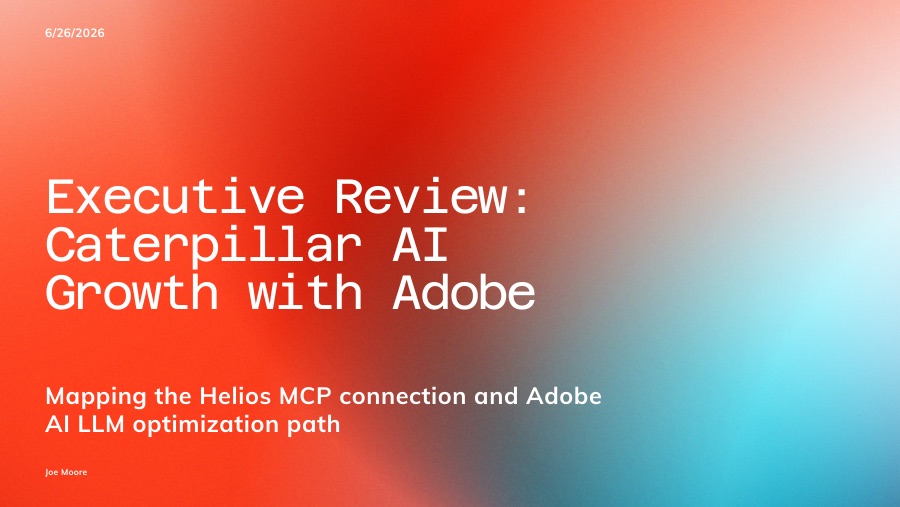
Executive Review: Caterpillar AI Growth
A 15-slide executive deck built in Adobe Express from the account research: the demarcation line, the Helios to Adobe flow through Model Context Protocol, the first AI wins, generative-search defense, and a 90-day activation plan.
Open the deck, PDF ↗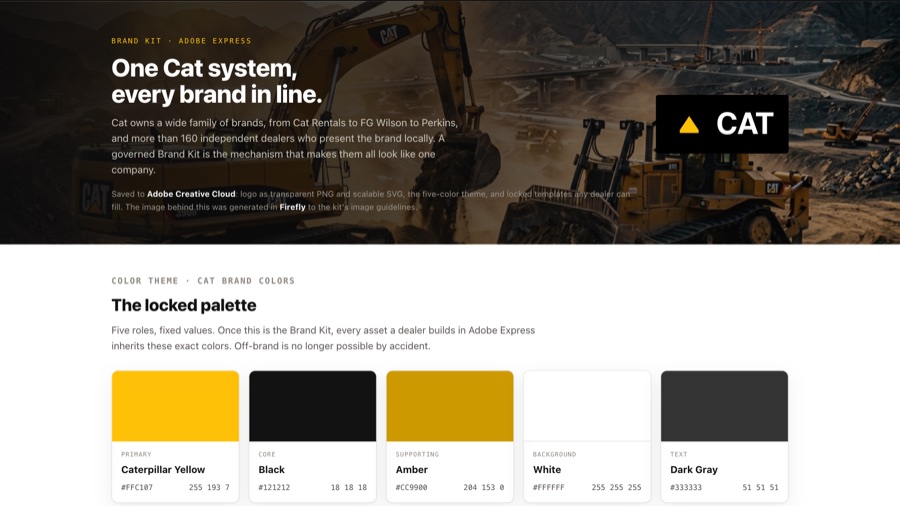
The Kit Brand Kit, brand governance modeled safely
A live Brand Kit built in Express for Kit, a fictional equipment brand used to model the play without any real marks: the locked palette, logo lockup, image and voice rules. Toggle the demo to watch a wall of mismatched sub-brands snap into one governed system.
Open the brand kit ↗Prep with it: this week
Present with it: in the room
Live demos, keep each under a minute, and screen-record the ones that could fail live. The point is not the output, it is that the artifact in front of the panel is the product working, and you are fluent enough to edit it under pressure. Firefly variations on the fly, a Customer Journey Analytics question answered in plain English, the Acrobat AI Assistant generating the panel's own questions from the job description, the Content Credentials provenance panel, a deck slide born from one prompt.
Proof: analogues already doing it.
Three starred anchors carry the argument; the rest is depth held in reserve for objections. Outcome figures from Adobe's public stories, approximate.
| Company | Adobe stack | The AI angle & outcome | Why it maps to CAT |
|---|
Volvo Trucks North America is the closest analogue: a heavy-equipment OEM selling big-ticket configurable machines through an independent dealer network, on AEM Sites + Edge Delivery. Henkel proves brand-trained Firefly Custom Models for an industrial B2B. Lumen is the strongest quantified GenStudio ROI (campaign launch 25 days to 9, about 3x faster asset production). And Caterpillar itself is already a public AEM customer, so the AI is the upsell onto a stack they already trust.
The 30-minute run sheet.
Thirty minutes. Open strategic, name the gap directly, close on the one number that must move.
Run of show
How you measure value over time
- Composite Customer Health Score reviewed every quarterly business review (usage, adoption breadth, engagement, sentiment, support health and executive sponsorship), shown with its methodology so execs can interrogate the number, not trust a curated slide.
- Adoption breadth and depth by solution: monthly active users and percent of licensed seats active across AEM, Real-Time CDP, Journey Optimizer, CJA, plus production use cases live versus entitled.
- AI Platform consumption tracked explicitly against the $0 baseline: agents activated, agent runs, Firefly generations, GenStudio assets. The single number that must move.
- Consumption pacing versus entitlement for usage-based products, so there is no shelfware now and no end-of-term true-down later.
- Value realization in Caterpillar's language: time-to-market per launch, content production cost per asset, campaign and journey conversion lift, cat.com performance, hours saved, aftermarket growth.
- Quantified ROI refreshed every QBR that specifically defends the about $950K Ultimate Success investment.
The risks, named and owned
Say it right.
A handful of names and attributions are routinely drafted wrong, then challenged in the room. The corrected forms are below. Everything not listed verified clean against Adobe's own documentation.
| Heard / drafted as | Verdict | Say it as |
|---|
Confirm entitlement, don't assert it
Features tagged "confirm entitlement" are real Adobe capabilities but may sit in a different SKU. Forecasting and Intelligent Captions live in Customer Journey Analytics, not classic Adobe Analytics. Predictive lead and account scoring comes via Real-Time CDP B2B, not core Marketo. Say "if it's in your entitlement" rather than promising it.
Attribute to the right product
Generative and agentic features move fast and get renamed. It is the Workfront Content Reviewer and Form Fill powered by AI; Firefly Creative Production / Bulk actions; a Text to Avatar API. When unsure, describe the capability and the value, not a brittle exact feature name.